
“I’m royally pi55ed right off”
“They’re a bunch of lazy ba57ards and need to step up or **** off”.
His business was growing fast, and he’d worked hard to get to this point. So, when he employed good people to help take the pressure off, he expected results. That’s fair.
Yet somehow, Roger (let’s call him Roger) was still the one working evenings, catching up at weekends and still taking responsibility for almost everything.
He’d watched his team chatting without a care in the world. Heard them complaining about how busy they are, despite having just spent twenty minutes talking about their weekend.
Meanwhile, he hadn’t even had time to eat lunch and have a wee!
What Roger really wanted to do was scream at them all to stop chatting, stop moaning about being overworked and get on with their damn jobs. And quite frankly, if they didn’t start pulling their weight soon, they might not have a job.
Why was he paying them if they weren’t making much difference to his stress levels, the fact the business was still reliant so much on him, the commercial growth or operational efficiency of his business?!
Sound familiar?
Now, when you pay people to do a job, you have every right to expect them to do it. And if they’re not, that’s something you need to address (appropriately, and preferably once you’ve calmed down!).
But what’s interesting about situations like Roger’s is…
What you think you’re angry about isn’t always what you’re actually angry about.
Roger was furious about his team chatting. But was that really the problem?
Or was he furious because, despite building a successful business and employing a leadership team, he was still working himself into the ground?
And what if some of the behaviour he was so angry about was something he’d unintentionally helped create?
When caring becomes carrying
Founders care. Leaders care. They have an enormous sense of responsibility for their people.
You care about them. You want them to enjoy working for you. You recognise when they’re under pressure and you don’t want to make their lives unnecessarily difficult.
These are great qualities and often part of why good people want to work for you. But overplayed, these qualities create a different leadership dynamic entirely.
Imagine, one of your managers is already stretched. Something else needs doing, but you know they’ve got a lot on. So rather than give them another responsibility, you take it on yourself.
Or perhaps they come to you with a problem. You can see they’re struggling, and because you’ve dealt with something similar a hundred times before, you know exactly how to resolve it. It’s quicker and easier to sort it yourself. So you do.
Or you delegate something, but when it doesn’t progress as quickly as you’d like, you step back in to get it finished.
None of these decisions seems particularly significant at the time, because you’re being supportive, protecting your team and it gets the job done.
But something else is happening, often without you even realising it.
You’re gradually taking responsibility away from the very people you’ve employed to have it, and the more often you do this, the more everyone gets used to and expects you to be the person who steps in.
It becomes a part of your role.
The Rescue Cycle
I call this pattern The Rescue Cycle, you may recognise it:
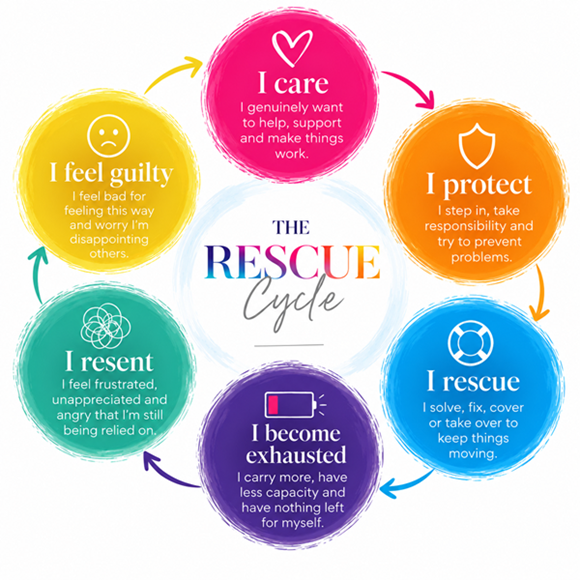
Look at where this cycle starts. It starts with caring, not poor intentions.
But eventually, your desire to protect your people can leave you doing, thinking and rescuing more than you should, while they become increasingly accustomed to relying on you.
And when you’re exhausted, watching other people laughing, chatting or leaving work on time can become explode-worthily irritating!
You start questioning their commitment or capability, maybe even resent paying their wages. Perhaps the actual issue is how you still have the weight of the world on your shoulders.
And then comes the guilt. You feel bad about being frustrated with people you genuinely care about. So you soften, protect them again, take a little more responsibility off their shoulders, and before you know it, you’re right back where you started – again!
Essentially every time you step in and take responsibility back, you may be making your team’s life easier in the short term, but you’re making your own life considerably harder in the long term.
Over time, it doesn’t just leave you exhausted and resentful. It leaves your team and business increasingly dependent on you, despite having employed good people to help run it.
That’s a commercial risk.
Hiring the wrong people?
Let’s face it sometimes we hire the wrong person, and sometimes people genuinely aren’t pulling their weight, and difficult conversations about performance and accountability are long overdue.
But there’s an important difference between a team that won’t take responsibility and one that’s on autopilot because they‘re used to having responsibility taken away.
So, if you’re the one working every weekend, increasingly exhausted and quietly resenting the people you’ve employed to help grow your business, perhaps it’s worth asking yourself:
How much of what you’re currently doing is genuinely yours to do vs your teams?